
Dofollow vs Nofollow Backlinks: What's the Difference?

Dofollow vs Nofollow Backlinks: What's the Difference?
Backlinks are a major factor in SEO, but not all backlinks work the same way. Here's the quick breakdown:
- Dofollow backlinks pass "link juice" (ranking authority) to your site, helping improve search rankings. These are the standard type of links.
- Nofollow backlinks include the
rel="nofollow"attribute, signaling search engines not to pass authority. They don't directly boost rankings but still drive traffic and build brand awareness.
Key takeaway: A balanced backlink profile with both dofollow and nofollow links is essential for SEO success. Dofollow links boost authority, while nofollow links contribute to traffic and a natural-looking link profile.
Quick Comparison
| Feature | Dofollow Backlinks | Nofollow Backlinks |
|---|---|---|
| HTML Code | <a href="url">Text</a> |
<a href="url" rel="nofollow">Text</a> |
| Passes Authority | Yes | No (treated as a hint by Google) |
| SEO Impact | Directly improves rankings | Indirect (traffic, visibility) |
| Use Case | Editorial links, guest posts, etc. | Paid ads, social media, comments, etc. |
Both types of backlinks are important. The rest of the article dives deeper into how they work and how to use them effectively.
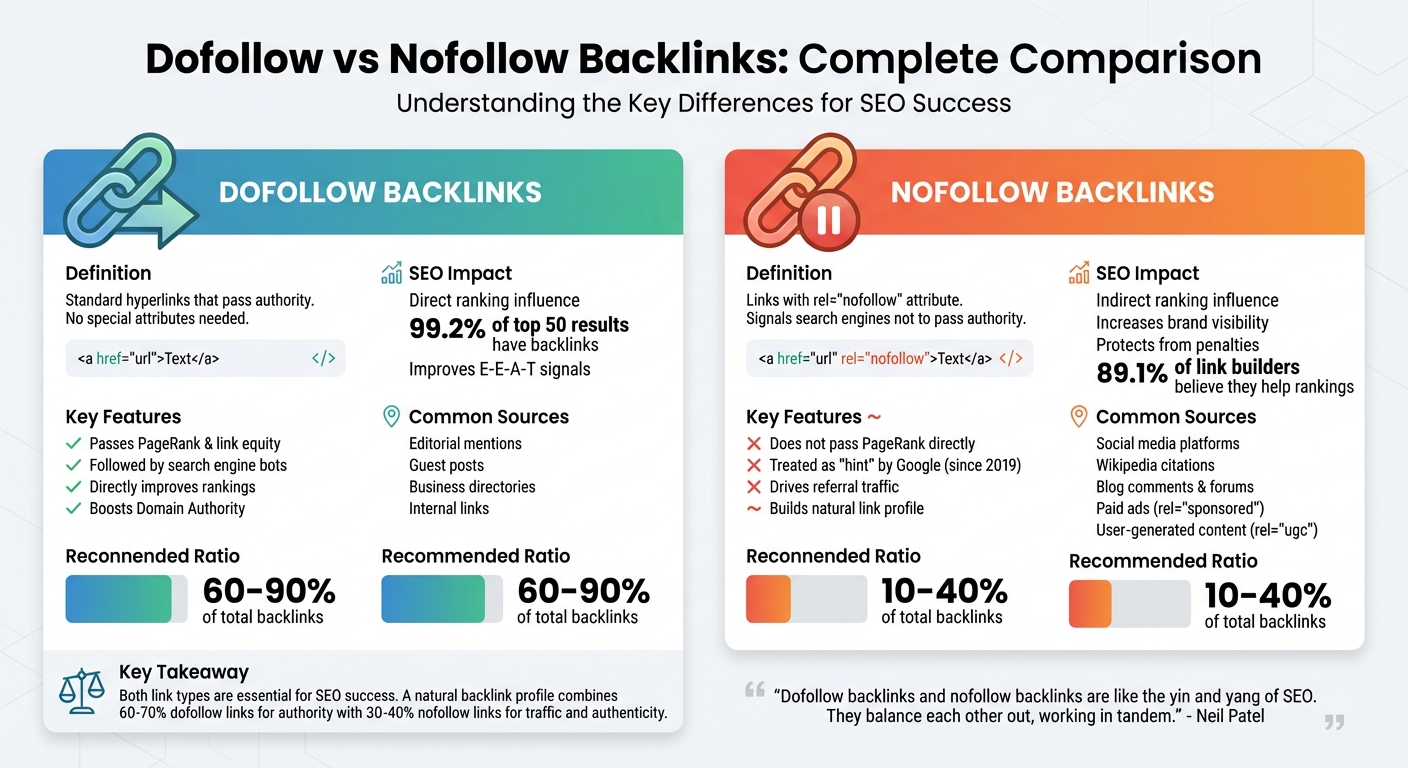
Dofollow vs Nofollow Backlinks Comparison Chart
What's The Difference Between Do Follow and No Follow Links
What Are Dofollow Backlinks?
A dofollow backlink is a regular hyperlink that search engine crawlers follow automatically, as it doesn’t include attributes like rel="nofollow", rel="ugc", or rel="sponsored". These links pass along what’s known as link equity (or "link juice"), transferring authority from the referring site to the linked page.
"Dofollow links are like the golden tickets of the SEO world. When a website links to another site with a dofollow link, it endorses the target page as trustworthy." - Neil Patel, Co-Founder, NP Digital
Earning dofollow links from credible websites can significantly increase your site's trust and PageRank - a metric Google has depended on for over 18 years. This, in turn, strengthens your site’s authority in search engine algorithms.
Key Features of Dofollow Backlinks
Dofollow links stand out for two main reasons:
- They transfer PageRank and authority from the source site to the destination page.
- Search engine bots follow these links to discover, index, and better understand your site's structure.
The SEO impact of a dofollow link depends on several factors, such as the linking site’s authority, its relevance to your niche, the anchor text used, and the placement of the link on the page. Links embedded within the main content typically carry more weight compared to those in footers or sidebars. To check if a link is dofollow, right-click on it in your browser, choose "Inspect", and ensure the rel="nofollow" attribute isn’t present.
Examples of Dofollow Backlinks
Dofollow links can appear in a variety of scenarios, including:
- Editorial Mentions: When respected blogs or news outlets reference your content, these links act as endorsements of your website.
- Guest Post Contributions: Publishing well-crafted guest articles on industry websites often includes links back to your site.
- Business Directory Listings: Sites like Directory Hunt allow businesses to list their profiles, often including dofollow links that add credibility to your site.
- Internal Linking: Using dofollow internal links helps search engines understand your site’s hierarchy and ensures link equity is distributed effectively.
Next, we’ll explore how nofollow backlinks differ.
What Are Nofollow Backlinks?
A nofollow backlink includes the rel="nofollow" attribute within the <a> tag. This tells search engine crawlers not to pass authority from the referring page to the destination page. Unlike dofollow links, which can boost a site's authority and rankings, nofollow links don't directly impact PageRank or search engine positions. Google introduced the nofollow attribute back in 2005 to combat spam in comments and manipulative link-building tactics. However, since September 2019, Google has treated nofollow as a "hint" rather than a strict rule. This means Google might still follow the link or factor it into ranking decisions in certain cases.
"Nofollow links, though they don't directly impact rankings, offer SEO benefits, such as driving traffic, increasing brand visibility, and building a natural link profile."
- Daria Chetvertak, SEO and Content Marketing Expert at SE Ranking
Having a mix of both nofollow and dofollow backlinks is critical for a healthy link profile. A profile made up entirely of dofollow links can appear manipulative to search engines and might result in penalties. Interestingly, pages that rank first on Google often have 3.8 times more backlinks than lower-ranking pages, highlighting the importance of a diversified link strategy.
Key Features of Nofollow Backlinks
Nofollow backlinks don’t pass PageRank or authority from the source site to your page, so they won’t directly improve your search rankings. While search engines may still crawl these links, they treat them as hints rather than definitive signals. This makes their SEO value indirect - they can drive referral traffic, increase brand exposure, and contribute to a balanced link profile.
"My perspective is that a mix of various types of links looks natural and won't show up as a suspicious pattern in the long-term. Spread the gain, spread the risk!"
- Bibi Raven, Founder of Bibibuzz
In 2019, Google introduced two additional attributes to complement nofollow: rel="sponsored" for paid links and rel="ugc" for user-generated content. These provide more specific context than the general nofollow tag.
Examples of Nofollow Backlinks
Some of the most common sources of nofollow links include major social media platforms. These platforms automatically apply the nofollow attribute to all outbound links. While these links don’t pass SEO authority, they can still drive traffic and boost visibility.
- Wikipedia: All external citations are tagged with nofollow to maintain editorial neutrality.
- Quora: Outbound links in answers are nofollow but can still generate significant referral traffic.
- Reddit: Links in user comments are marked nofollow to discourage spam.
- Blog comments and forums: Often use nofollow (sometimes combined with
rel="ugc") to prevent spam.
Paid advertisements and sponsored posts should always include the nofollow tag - or the more specific rel="sponsored" attribute - to comply with Google’s Webmaster Guidelines. Similarly, press releases distributed via services like PR Newswire typically include nofollow links to adhere to search engine rules for syndicated content. These examples show how nofollow links, while indirect in their impact, still play a vital role in building a well-rounded online presence.
Dofollow vs Nofollow: Technical Differences
Let’s dive into the technical distinctions between dofollow and nofollow backlinks to understand how they function and impact search engines.
At its core, the difference lies in how search engines interpret these links. Dofollow links are standard hyperlinks without any special attributes, allowing search engine crawlers to follow them naturally. On the other hand, nofollow links include a specific attribute in their code: rel="nofollow". For example: <a href="url" rel="nofollow">Text</a>.
Dofollow links pass authority (often referred to as "link juice") to the linked page, directly influencing its rankings. Nofollow links, while initially designed to block this transfer, are now treated by Google as "hints." This means they may still impact rankings in certain contexts, depending on the link's value and relevance.
When it comes to crawling, search engines index dofollow links to discover new pages. For nofollow links, Google treats them as suggestions - bots may choose to follow them if they seem valuable enough.
"All the link attributes - sponsored, ugc, and nofollow - are treated as hints about which links to consider or exclude within search."
- Google Search Central
Another outdated SEO tactic involved using nofollow on internal links to manipulate authority distribution. Google has since clarified that any "link equity" from a nofollow link simply vanishes, rather than being redistributed among other links on the page.
Here’s a quick breakdown of the technical differences between these two types of backlinks:
Comparison Table: Dofollow vs Nofollow Backlinks
| Feature | Dofollow Backlinks | Nofollow Backlinks |
|---|---|---|
| HTML Code | <a href="url">Text</a> |
<a href="url" rel="nofollow">Text</a> |
| Default Status | Yes (standard link) | No (requires specific attribute) |
| PageRank Transfer | Passes link equity/authority | Generally does not pass equity (hint only) |
| Crawling Behavior | Followed by search bots | Treated as a hint; may be followed |
| SEO Impact | Directly influences rankings | Indirect impact (e.g., traffic, awareness) |
| Primary Use Case | Editorial citations, internal links | Paid ads, user-generated content, untrusted sources |
This comparison highlights how each link type serves distinct purposes in SEO strategy. While dofollow links are essential for boosting authority, nofollow links still play a role in building traffic and credibility.
sbb-itb-5806a15
Boost Your Project's Visibility
Submit your project to Directory Hunt to gain visibility, reach early adopters, and connect with a community of makers and entrepreneurs.
Submit Your ProjectSEO Impact of Dofollow Backlinks
Dofollow backlinks play a critical role in improving search engine rankings by passing "link equity" (often called "link juice"). This process transfers ranking strength from the linking page to your site, signaling to search engines that your content is both valuable and trustworthy. This boost often translates into higher positions in search results.
Here’s a striking statistic: 99.2% of all top 50 search results have at least one backlink pointing to their site. Beyond improving rankings, dofollow links also enhance metrics like Domain Authority (DA) and Page Authority (PA) - indicators of how well your site might rank. Additionally, they strengthen your site's E-E-A-T (Experience, Expertise, Authoritativeness, and Trustworthiness), which is a key factor in Google's content quality evaluations. Another advantage? They help search engines discover and index new pages faster, keeping your site visible and up-to-date.
Striking the right balance is crucial. A natural backlink profile typically includes 60% to 90% dofollow links. This ratio helps demonstrate authenticity to search engines and avoids penalties tied to manipulative link-building tactics. By focusing on quality backlinks, you not only improve SEO metrics but also create a stronger foundation for your overall digital marketing strategy.
Best Practices for Building Dofollow Backlinks
Creating effective dofollow backlinks requires a deliberate approach that emphasizes value and genuine connections. Here are some strategies to consider:
- Develop linkable assets: Create resources like original research, detailed guides, infographics, or interactive tools. These assets should provide unique value and be difficult for competitors to replicate, naturally attracting links from well-regarded sites.
- Broken link building: Search for broken links on authoritative sites in your niche. Reach out to site owners, suggesting your content as a replacement. This not only helps them fix an issue but also earns you a high-quality backlink.
- Guest posting: Contribute articles to respected industry blogs. For example, in April 2025, SEO expert Nick LeRoy secured a dofollow backlink by publishing a guest post on Moz’s blog, linking back to his site and newsletter.
- Digital PR: Pitch unique stories or expert insights to journalists and media outlets. Platforms like Connectively (formerly HARO) or Qwoted allow you to respond to media queries, often resulting in dofollow backlinks when credited.
- Directory submissions: Submitting your site to reputable, niche-specific directories can strengthen your backlink profile. For instance, Prime Solicitors improved their local SEO by listing in high-quality directories like The Law Society. Tools like Directory Hunt can simplify the process of finding relevant directories.
- Business relationships: Ask partners, suppliers, or distributors for backlinks. Being featured on a "preferred vendor" list or offering a testimonial for a service provider can lead to valuable dofollow links.
Lastly, make it a habit to audit your backlink profile regularly. Ensure your dofollow links come from relevant, high-quality domains. Links from spammy sources can harm your rankings and may even result in penalties. By focusing on quality over quantity, you can build a strong and reliable backlink strategy.
SEO Impact of Nofollow Backlinks
While it's true that nofollow links don’t pass PageRank, they still play a vital role in driving referral traffic and boosting user engagement. These actions can indirectly signal content quality to search engines. For example, links from high-traffic platforms like Forbes or Quora can bring in significant traffic and even lead to conversions. This kind of visibility often snowballs into organic dofollow links as new audiences discover and reference your brand on their own websites or social media.
Since September 2019, Google has started treating nofollow links as a "hint" rather than a strict rule. Alongside this, they introduced the rel="ugc" and rel="sponsored" attributes, giving website owners more control over how links are categorized. This shift highlights the importance of maintaining a naturally diverse backlink profile.
Using nofollow, particularly with the rel="sponsored" attribute for paid links, aligns with Google’s Webmaster Guidelines and can safeguard your site from penalties. Experts emphasize that nofollow links can still generate high-quality referral traffic, making them an essential part of a well-rounded backlink strategy.
Rather than dismissing nofollow links, consider their broader benefits. They contribute to a natural link profile, bring in qualified traffic, and indirectly support rankings by increasing brand exposure and user interaction. Tools like Directory Hunt can help you incorporate nofollow links effectively into a larger backlink strategy.
Balancing Your Backlink Profile
To build a sustainable SEO foundation, it’s crucial to maintain a balanced mix of link types. Search engines expect backlink profiles to reflect genuine, organic online activity rather than manipulative practices. Many SEO professionals recommend a ratio of 60–70% dofollow links and 30–40% nofollow links for a healthy profile.
Regular audits of your backlink profile using SEO tools can help identify potential red flags, such as an overuse of exact-match, keyword-heavy anchor text in dofollow links. Balancing these with nofollow links or branded anchors creates a more natural and credible profile. For instance, research on the Ahrefs blog shows that about 85% of its referring domains are dofollow, demonstrating that even top-performing sites maintain a mix of link types.
The focus should always be on the quality and relevance of the link, not just its attribute. A nofollow link from a high-authority, relevant site can still provide immense value through referral traffic and brand association. As Alex Wright, SEO & Performance Marketing Director at Clicky Media, puts it:
"Ultimately, your link profile should look natural, and having a good mix of both is a big part of that."
For internal linking, ensure that critical pages are dofollow to support your site’s structure and indexing. Use nofollow strategically for less important pages, like login screens or registration forms, to optimize your crawl budget.
Comparison Table: Benefits and Drawbacks of Nofollow Backlinks
| Feature | Benefits | Drawbacks |
|---|---|---|
| SEO Impact | Helps create a natural link profile, serving as a ranking hint. | Does not pass traditional link equity. |
| Traffic | Drives referral traffic from high-authority, high-traffic platforms. | Requires placement on well-trafficked sites. |
| Brand Impact | Boosts brand exposure and visibility to new audiences. | Offers less direct influence on domain authority. |
| Safety | Protects against penalties for paid or low-trust links. | May be ignored by some automated SEO tools. |
| Acquisition | Easier to obtain compared to dofollow links. | Has a weaker impact on keyword rankings. |
Using Directory Hunt for Dofollow Backlinks
Dofollow backlinks are a powerful way to boost your site's authority by passing link equity, and Directory Hunt makes it easier to secure those valuable links. This platform connects users with high-quality directories that can enhance search visibility. It offers both free submissions and automated tools to streamline the process, making it a practical choice for projects looking to build authority.
Anastasia Kotsiubynska, Head of SEO at SE Ranking, emphasizes the importance of backlinks: "High-quality backlinks are among the top two influential factors, alongside content". For newer projects, directory submissions are an excellent starting point for establishing domain authority. Directory Hunt simplifies this process, making it accessible even for those with limited resources.
How Directory Hunt Supports SEO
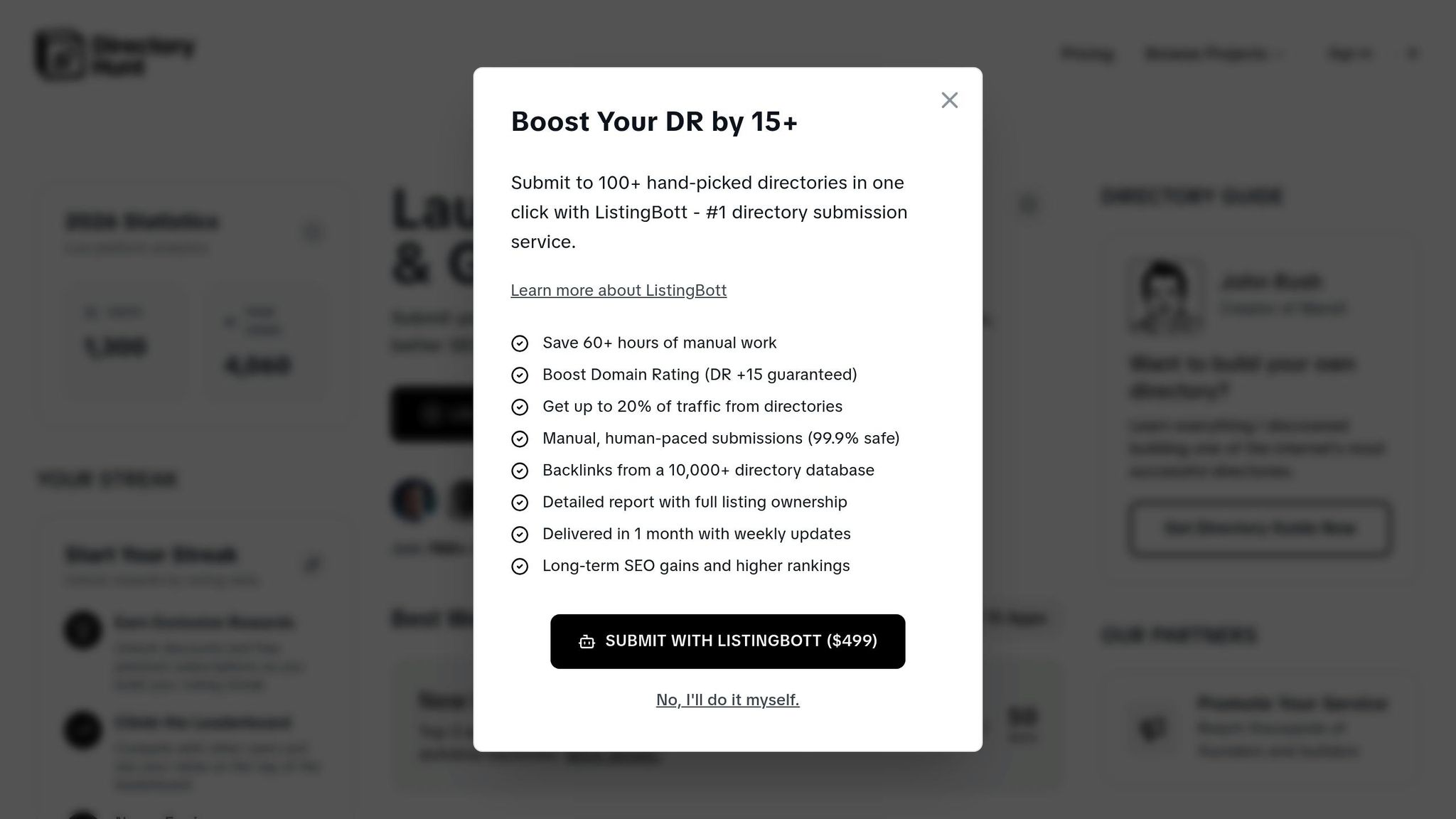
Directory Hunt offers access to a curated list of directories where you can submit your project and earn dofollow backlinks. These links signal to search engines that your content is credible and valuable. To make the process even easier, the platform includes a service called ListingBott, which automates submissions to over 100 directories for $499. This feature saves significant time and effort compared to manual submissions.
Dofollow backlinks from directories not only pass authority but also help with faster indexing and improved rankings for target keywords. As Lukas Rasmussen, SEO Lead at Morningscore.io, explains: "Dofollow backlinks are the 'original' type of links that pass value (also known as link juice) between web pages. Google uses these links to increase the PageRank value of the linked page".
Aside from the technical benefits, directory submissions can also boost your project's visibility to users actively searching for tools or solutions. This is particularly helpful for startups operating on tight budgets. By optimizing your submissions, you can maximize these benefits, as explained below.
Getting Better Results with Directory Hunt
To get the most out of Directory Hunt, focus on crafting high-quality project descriptions. Use natural, relevant keywords in your anchor text to help search engines understand your content. Shreya, SEO Specialist at Bizz Buzz Creations, highlights this point: "A dofollow backlink allows Google to crawl your website and pass on link juice + authority".
If you’re using ListingBott’s automated submission tool, make sure your project details are well-prepared and compelling before submitting. The service provides detailed reports so you can track which directories are delivering the best results. However, the success of your link-building efforts still depends on the quality of the information you provide.
Lastly, aim for a balanced backlink profile by combining directory backlinks with other link types, like nofollow links from social media or forums. By building a strong foundation of dofollow links through Directory Hunt and diversifying your strategy, you can create a more natural and effective backlink profile.
Conclusion: Choosing the Right Backlink Strategy
Understanding the differences between backlink types is just the beginning; the real value lies in using both effectively to build a well-rounded, impactful profile. Dofollow links help pass authority and improve search rankings, while nofollow links drive referral traffic, enhance brand visibility, and safeguard against penalties. A balanced approach, as outlined earlier, is key to long-term success.
"Dofollow backlinks and nofollow backlinks are like the yin and yang of SEO. They balance each other out, working in tandem." - Neil Patel, Co-Founder, NP Digital
This quote perfectly captures the essence of balance, which has been central to this discussion.
Relying solely on dofollow links can raise red flags with search engines, as a 100% dofollow profile appears unnatural. In contrast, nofollow links - especially from high-traffic sites - can increase visibility and often lead to organic dofollow links over time. Interestingly, 89.1% of link builders believe that nofollow links contribute to search rankings in some way. The real takeaway? Focus on quality and relevance, rather than obsessing over whether a link is dofollow or nofollow.
To build a strong backlink profile, aim for diversity and authenticity. Regularly monitor your backlink ratio using SEO tools, and remember that both link types are essential pieces of the SEO puzzle. By applying these strategies, you can create a sustainable and effective SEO plan that maximizes the potential of every link.
FAQs
Can nofollow backlinks still help improve my site's SEO?
Nofollow backlinks might not directly boost your rankings since they don’t pass link equity, but they can still offer indirect SEO benefits. For starters, they can drive referral traffic by bringing users to your site from other platforms. Plus, they help increase brand visibility, putting your name in front of a broader audience.
Another key advantage? They contribute to creating a natural backlink profile, something search engines appreciate. When your site appears across various online spaces, it enhances credibility and can even lead to organic opportunities for dofollow links down the road. Over time, these factors can support your site's authority and overall search engine performance.
What’s the best balance of dofollow and nofollow backlinks for a natural link profile?
A natural link profile doesn’t need a specific ratio of dofollow to nofollow backlinks. Instead, it should have a balanced mix of both. This variety makes your site look more organic to search engines, helping you avoid potential penalties.
Put your energy into earning high-quality dofollow backlinks, as they can directly improve your SEO. At the same time, don’t overlook nofollow links - they still bring traffic and can help increase your brand's visibility. The goal is to focus on genuine, authentic links rather than chasing a perfect percentage.
Why should your backlink strategy include both dofollow and nofollow links?
A well-rounded backlink strategy incorporates both dofollow and nofollow links, and this balance is key to strengthening your online presence. Dofollow links pass authority to your website, which can boost your search engine rankings. On the other hand, nofollow links, while they don’t directly influence rankings, can still drive referral traffic, improve brand awareness, and help create a more natural, varied backlink profile.
Search engines prioritize authenticity. A mix of both link types indicates that your site is earning links organically, rather than trying to artificially boost its authority. This balanced approach not only supports sustainable SEO growth but also builds trust and credibility for your site.