
How to Get Quality Backlinks for Your New Project

How to Get Quality Backlinks for Your New Project
Backlinks are critical for improving your website's search engine rankings, increasing authority, and driving targeted traffic. For new projects, the key is focusing on quality over quantity. High-quality backlinks from trusted sources hold more value than numerous low-quality links. Here's a quick breakdown of actionable strategies:
- Directory Submissions: Submit your project to reputable directories like Product Hunt or Indie Hackers. These platforms provide dofollow backlinks and attract relevant audiences.
- Guest Blogging: Write for established blogs in your niche to gain natural, contextual backlinks.
- Partnerships: Collaborate with other brands or offer testimonials for backlinks.
- Tracking Tools: Use tools like Ahrefs and SEMrush to identify backlink opportunities, monitor progress, and audit harmful links.
Key Insight: Tools like Directory Hunt simplify directory submissions, while automated options like ListingBott save time by submitting to over 100 directories for $499. Always ensure your backlinks come from trusted, high-authority sources to maximize SEO benefits.
How to Create Backlinks to Your Site in 2025 (that actually help rank)
Building Backlinks Through Directory Submissions
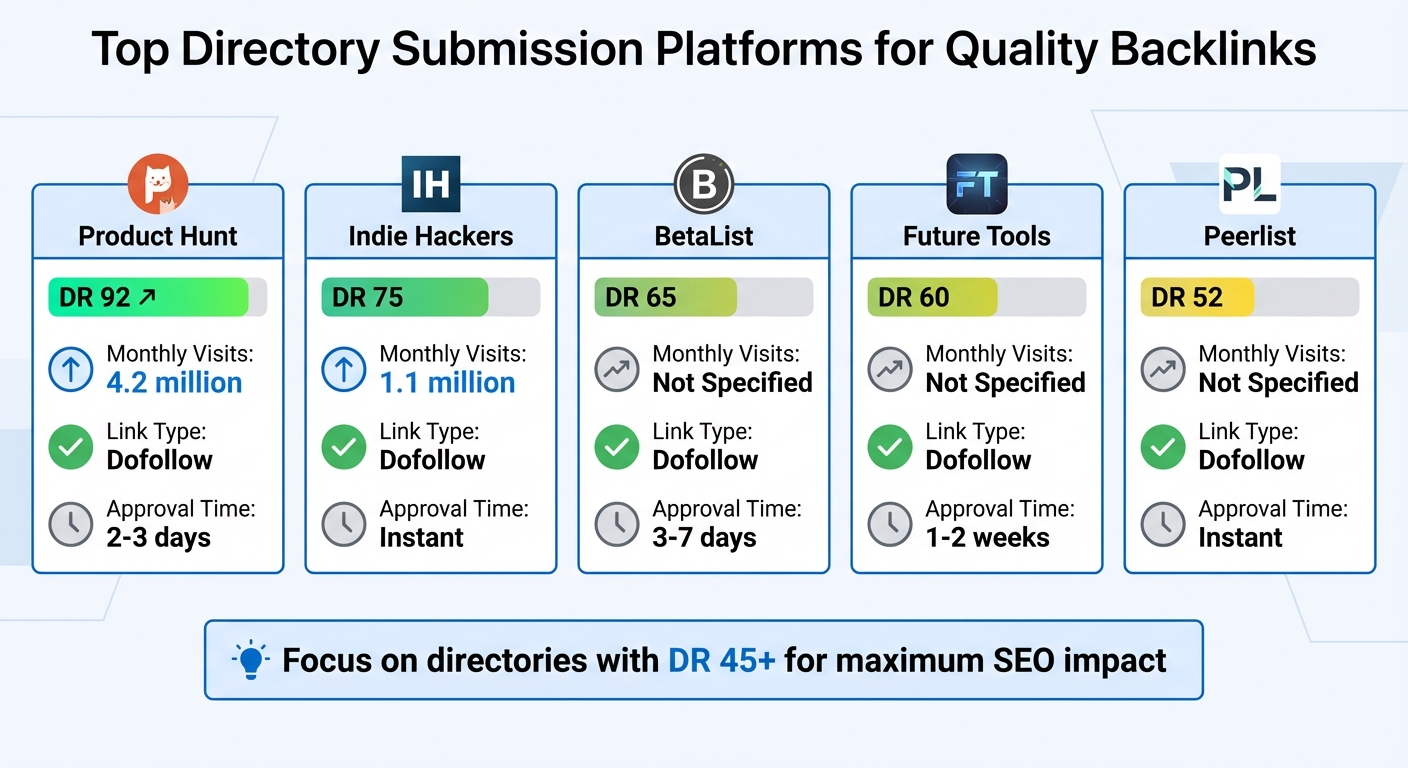
Top Directory Submission Platforms: Domain Rating, Traffic & Approval Times Comparison
Directory submissions are one of the easiest and most budget-friendly ways to earn quality backlinks, especially for a new project. Unlike guest blogging or forming partnerships, which can be time-consuming, directory submissions offer a quicker route to results. The key is to focus on curated, high-authority directories rather than outdated link farms, which can negatively impact SEO. Here's how these submissions can boost your SEO efforts.
How Directory Submissions Improve SEO
Submitting your site to high-quality directories can provide valuable dofollow backlinks from authoritative platforms. For instance, when you list your project on a directory with a Domain Rating (DR) of 45 or higher, you gain a backlink that passes link equity directly to your website.
But the benefits don't stop there. Modern AI tools like ChatGPT, Perplexity, and Google's AI Overviews now use directory listings to identify credible brands in specific niches.
"A backlink from Product Hunt (DR 92) costs $0 and gives you more SEO juice than most $500/month SEO packages." – Krzysztof, Founder, LaunchDirectories
Timing is everything when launching a new project. High-authority directories are crawled frequently by search engines, meaning your listing can get indexed in just a few days, compared to weeks for other methods. This speed can translate into quicker SEO gains.
Additionally, directory submissions can drive referral traffic. Platforms like Product Hunt (4.2 million monthly visits) and Indie Hackers (1.1 million monthly visits) attract audiences who are actively looking for new tools and products. These aren't just random visitors - they're potential customers who are already interested in finding solutions like yours.
| Directory | Domain Rating (DR) | Monthly Visits | Link Type | Typical Approval Time |
|---|---|---|---|---|
| Product Hunt | 92 | 4.2 million | Dofollow | 2-3 days |
| Indie Hackers | 75 | 1.1 million | Dofollow | Instant |
| BetaList | 65 | Not specified | Dofollow | 3-7 days |
| Future Tools | 60 | Not specified | Dofollow | 1-2 weeks |
| Peerlist | 52 | Not specified | Dofollow | Instant |
Using Directory Hunt for Project Submissions
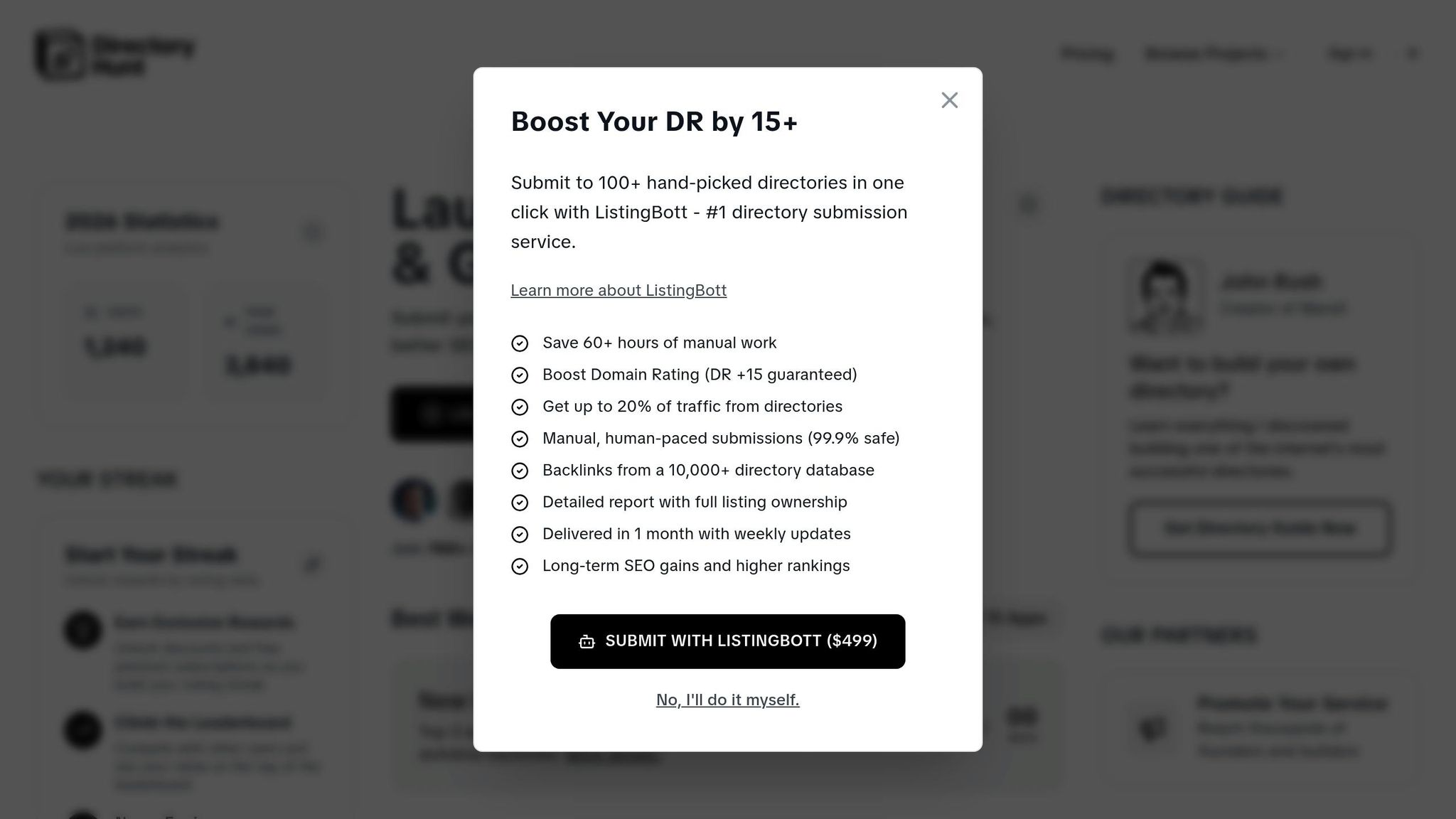
To make the process even easier, Directory Hunt streamlines submissions and helps you secure those all-important backlinks. It offers a centralized platform with curated directories across categories like AI, marketing, and productivity. This means you can quickly find relevant opportunities without spending hours researching.
Directory Hunt provides a free plan for basic submissions and a premium $499 ListingBott service that automates submissions to over 100 directories. It also includes detailed backlink reports, so you can track your progress.
Rather than focusing on sheer volume, Directory Hunt emphasizes quality. The platform ensures submissions are made to directories with dofollow backlinks and strict editorial standards. This approach helps boost your domain authority and search rankings without wasting time on low-quality platforms.
How to Submit Your Project on Directory Hunt
Directory Hunt offers two submission options: a free manual submission or the automated ListingBott service. Both are designed to help you secure quality backlinks without the hassle of submitting to individual directories.
Creating Your Project Profile
Start by creating a compelling project profile. Make sure your description highlights your project's strengths and includes relevant keywords. Add high-quality visuals, such as screenshots or demo videos, to make your listing stand out. Consistency is key - ensure your NAP (Name, Address, Phone number) details are accurate across all platforms. Include a clear call-to-action like "Start your free trial" or "Request a demo", and select the most relevant category for your project. Once your profile is ready, select the submission method that matches your goals and timeline.
Using the Free Submission Plan
If you prefer a hands-on approach, the free submission plan allows you to manually submit your project. After registering your account, fill in the project details and submit them for review. Keep in mind that free submissions often take longer to be approved - sometimes several weeks. However, this plan gives you access to Directory Hunt's curated list of directories, ensuring your project aligns with their editorial standards.
Using ListingBott for Automated Submissions
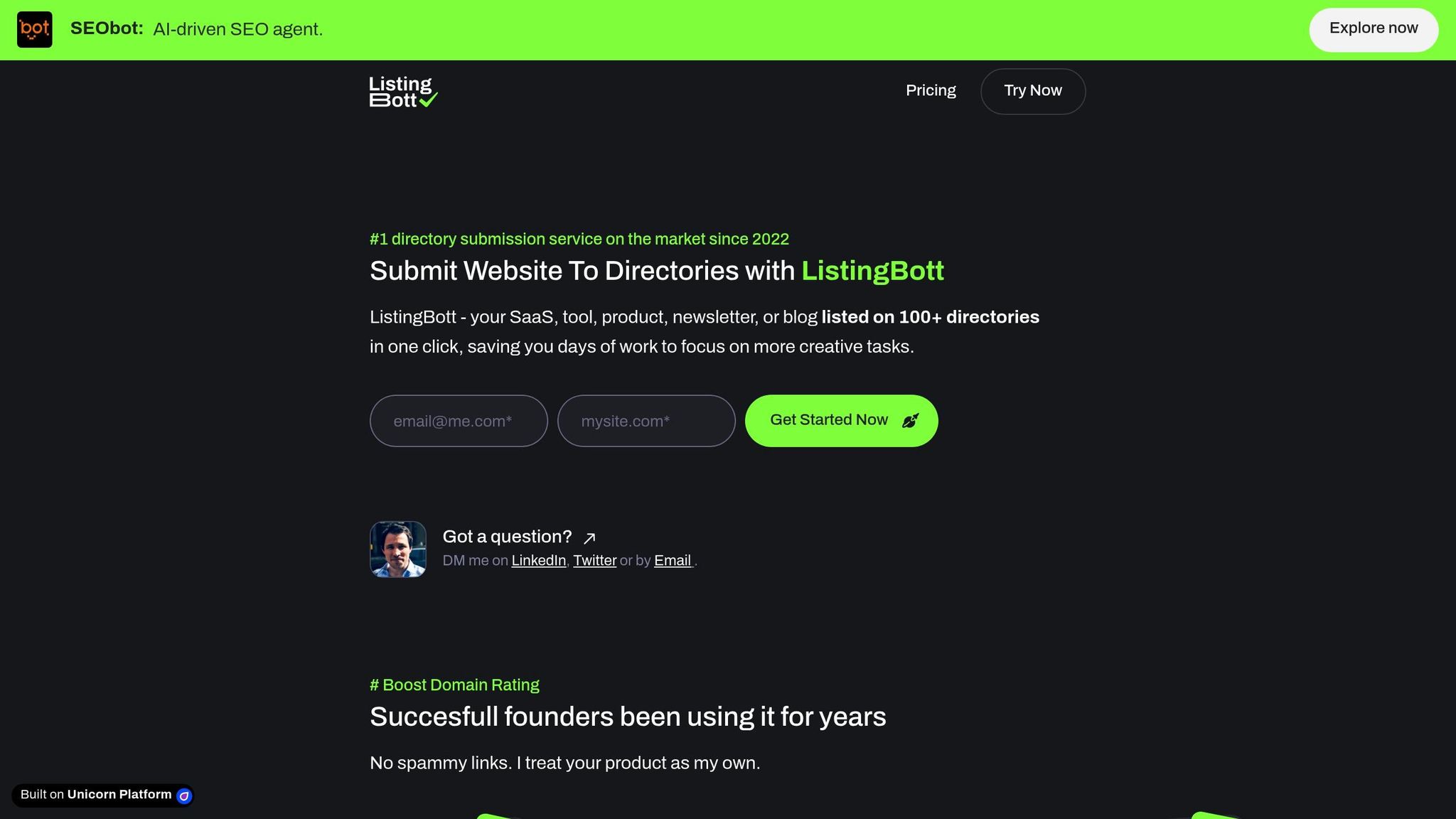
For those looking to save time and scale efficiently, ListingBott is a great option. For $499, ListingBott automates the entire submission process by identifying relevant directories and submitting your project for you. Through its dashboard, you can track submission progress, review backlink reports, and analyze performance. This automation speeds up indexing, which can lead to quicker SEO improvements and earlier referral traffic. ListingBott prioritizes directories that provide dofollow backlinks and maintain strict editorial standards, helping you build authority without compromising quality.
Improving Your Directory Listing for SEO
Submitting your project is just the beginning. To maximize SEO benefits, use natural, keyword-rich anchor text in your description while avoiding anything that might appear spammy. Key details should be placed in the main body of your listing to ensure they carry more SEO weight. Add trust-building elements like founder bios, social media links, and clear contact details to enhance credibility with both users and search engines. Regularly audit your listing to keep information accurate and consistent, as outdated or mismatched NAP details can harm your local search rankings. Ongoing updates and optimizations will strengthen your project's reputation and improve visibility in search results.
"The best way to get other sites to create high-quality, relevant links to yours is to create unique, relevant content that can naturally gain popularity in the Internet community." – Matt Cutts, Former Head of Google Web Spam
sbb-itb-5806a15
Boost Your Project's Visibility
Submit your project to Directory Hunt to gain visibility, reach early adopters, and connect with a community of makers and entrepreneurs.
Submit Your ProjectOther Methods for Building Backlinks
Expand your backlink strategy by combining directory submissions with guest blogging and forming strategic partnerships. Let’s dive into how guest blogging can strengthen your backlink profile and how partnerships can open doors to more opportunities.
Getting Backlinks Through Guest Blogging
Guest blogging is a powerful way to introduce your content to an already engaged audience. The real value lies in earning contextual links - those placed naturally within the article itself, rather than being tucked away in an author bio. These links carry much more SEO weight. Plus, links from high-quality guest posts can help AI tools like ChatGPT and Google AI Overviews recognize your brand as a trusted authority.
To find guest blogging opportunities, start with simple Google searches using operators like [your keyword] + "write for us" or [your keyword] + "guest column". Focus on blogs with a Domain Authority over 35 and at least 1,000 monthly organic visitors. Before pitching, take time to engage with the blog’s editors - comment on their posts or connect with them on social media. This makes your pitch feel more personal and increases your chances of success.
When reaching out, keep your email short (under 150 words). Compliment their content, suggest 2-3 topic ideas tailored to their audience, and include a link to one of your best posts. On average, you can expect about a 5% success rate - earning roughly 5 backlinks for every 100 pitches. Today’s approach is all about being an expert first and a link builder second. Publishers are looking for insightful, unique content over generic submissions.
"Don't guest blog for links. Instead, guest blog only when you have an original insight to share on a topic you already understand." – Dmitry Dragilev
If guest blogging isn’t enough, partnerships can provide even more ways to build valuable backlinks.
Building Backlinks Through Partnerships
Strategic partnerships are a win-win for everyone, creating opportunities for mutually beneficial backlinks. Start by auditing your tech stack - offering testimonials in exchange for a backlink on a partner’s homepage is an easy first step. You can also collaborate with non-competing startups that share your audience. Think joint research projects, webinars, or co-authored content.
Competitor analysis can also uncover partnership opportunities. Tools like Ahrefs or SEMrush can show you where your competitors are getting their backlinks, helping you identify potential collaborators. Additionally, keep an eye on unlinked mentions of your brand using tools like Brand Monitoring or simple Google search operators. A polite request can often turn those mentions into links.
Another effective method is signing up for media request platforms like HARO (Help a Reporter Out), Connectively, or Featured.com. These platforms connect you with journalists looking for expert quotes, which can result in backlinks from high-authority sources.
"The best link building in 2025 doesn't look like building at all - it looks like earning trust, creating value, and fostering relationships." – SeoInventiv
Tools for Finding and Tracking Backlink Opportunities
Streamline your backlink-building efforts with tools designed to uncover and monitor opportunities. These tools not only save time but also highlight hidden possibilities. Metrics like Domain Rating (DR) and URL Rating (UR) from Ahrefs, or Authority Score (AS) from SEMrush, help assess link quality effectively.
When searching for backlinks, aim for sites with a DR or AS above 50 and at least 1,000 monthly organic visitors. High authority scores mean little if the site lacks traffic, which could signal manipulated profiles.
Finding Backlink Sources with Ahrefs
Ahrefs is a go-to for competitor analysis and content-focused link-building. Its Link Intersect feature in Site Explorer is particularly useful, showing domains that link to competitors but not to your site. Additionally, Content Explorer helps locate niche-relevant pages, broken links, and unlinked brand mentions. You can filter by Domain Rating and traffic to refine your search.
One example of Ahrefs in action is Search Intelligence’s campaign using Ahrefs Keywords Explorer to analyze search volumes related to fraud among UK banks. This data-driven approach gave journalists a compelling story angle on bank security, resulting in over 60 backlinks from high-authority sites like Yahoo News (DR 92) and Time magazine (DR 92). Another standout case occurred in July 2022, when Yard, a marketing firm, released a study on CO2 emissions from celebrity private jets. The campaign went viral, earning backlinks from 1,861 referring domains, with 38.4% of those links coming from sites with a DR above 60.
Now, let’s explore how SEMrush complements these insights with its advanced backlink auditing tools.
Auditing Backlinks with SEMrush
SEMrush is an excellent tool for auditing and safeguarding your backlink profile. Its Backlink Audit tool flags harmful links using a 100-point Toxicity Scale, with scores above 60 considered problematic. It also tracks new and lost backlinks, allowing you to measure the impact of your outreach campaigns in real time. The Link Building Tool simplifies prospecting by targeting keywords and competitors, complete with email outreach management built in. Use the Lost filter to identify high-authority links that have recently disappeared and reach out to site owners to recover them.
The Backlink Gap feature is another standout, enabling you to compare your backlink profile against up to four competitors. This helps pinpoint where you’re falling behind. For even more precise toxicity scoring and to protect referral traffic, you can integrate Google Search Console and Analytics with SEMrush.
| Feature | Ahrefs | SEMrush |
|---|---|---|
| Primary Strength | Competitor analysis and content-based linking | Auditing, toxicity tracking, and outreach |
| Key Metric | Domain Rating (DR) and URL Rating (UR) | Authority Score (AS) and Toxicity Score |
| Discovery Tools | Content Explorer, Link Intersect | Link Building Tool, Backlink Gap, Monitoring |
| Monitoring | Growth charts, New/Lost reports | Automated audits, recrawls, and email alerts |
Conclusion
Creating quality backlinks isn't about quick fixes - it's about using a mix of strategies that work together to achieve lasting results. Combining directory submissions with guest blogging and partnerships can help you craft an SEO approach that strengthens your online presence over time.
Start by submitting your project to trusted directories like Directory Hunt, which offers dofollow backlinks that can boost your site's credibility. Remember, quality beats quantity - a single link from a high-authority source (Domain Authority above 35) can be far more impactful than dozens of low-quality links.
Once your directory submissions are in place, expand your efforts with guest blogging and strategic partnerships. Together, these strategies can help you build a strong backlink profile, establish authority, and attract highly targeted traffic to your site.
Use tools like Ahrefs and SEMrush to keep tabs on your progress. Track new referring domains each month and perform quarterly backlink audits to weed out any harmful links. These tools can also help you spot opportunities, like unlinked brand mentions or areas where competitors are outperforming you. By identifying these gaps, you can fine-tune your strategy and ensure all your efforts align with your broader SEO goals.
"Link building these days is more akin to great marketing, and the organizations who understand this are usually the ones who win long-term."
- Paddy Moogan, Co-founder, Aira
Ready to get started? Take advantage of Directory Hunt's free submission plan to lay the groundwork. Then, scale your efforts with tools like ListingBott, which automates submissions to over 100 directories. Pair these foundational steps with high-quality content and regular audits to build an SEO strategy that not only works now but continues to deliver results well into the future.
FAQs
How can directory submissions help improve my website's SEO?
Directory submissions can play a key role in improving your website's SEO by generating quality backlinks from reliable platforms. These backlinks act as a trust signal for search engines like Google, showing that your site is credible and worth ranking higher in search results. Submitting your website to established directories, such as Google My Business or Yelp, can also help boost both your local and broader online visibility.
Another advantage of directory submissions is that they help maintain consistent NAP (Name, Address, Phone) details across various platforms. This consistency strengthens local SEO efforts and ensures your business information is accurate and easy to find. By focusing on reputable directories and carefully completing your profiles, you can create valuable backlinks that enhance your website's authority and improve its overall search engine performance.
What defines a high-quality backlink, and why are they important?
A high-quality backlink is like a vote of confidence from a reputable, authoritative website within your industry or niche. These links essentially tell search engines, "This site is trustworthy and worth paying attention to."
Here’s what defines a strong backlink:
- Relevance: The linking website and its content should closely align with the topic of your page.
- Authority: Links from websites with high domain authority and solid trust metrics hold more influence.
- Context: Backlinks naturally placed within relevant, high-quality content are far more effective than those tucked away in sidebars or footers.
The key is to earn these links the right way - through ethical strategies rather than shortcuts or manipulative tactics. Doing so not only boosts your search rankings but also strengthens your brand's credibility over time.
How can I make sure my backlinks come from reliable and high-quality sources?
To get backlinks that genuinely help your site, aim to connect with well-respected websites in your industry. Focus on ethical tactics like guest blogging, fixing broken links on reputable sites, or converting unlinked brand mentions into backlinks. These approaches not only improve your link profile but also ensure the links you gain are reliable and beneficial.
Make sure to assess the quality of the websites you’re targeting for backlinks. Tools like Ahrefs and SEMrush can provide insights into a site's authority and relevance. Stay away from spammy or low-quality sites, as they can harm your SEO efforts. Instead, aim for backlinks from reputable websites with strong domain authority - this will enhance both your search engine rankings and your online credibility.